
Military veterans bring a set of capabilities that are genuinely rare in the civilian workforce. The technical skills are real, the U.S. military is one of the largest technical training organizations in the world, spending billions annually to develop expertise in electronics, propulsion, avionics, information technology, nuclear engineering, logistics, and manufacturing. But the less visible qualities may matter even more: the ability to operate with precision under pressure, to follow critical procedures without shortcuts, and to take full accountability for outcomes in environments where failure has real consequences.
For technical and engineering programs that demand both competence and reliability, veterans are frequently exceptional hires. The challenge is that civilian hiring processes often don’t know how to recognize or evaluate military backgrounds, and good candidates get passed over as a result.
The Technical Skills Are Real and Deep
Military service produces highly trained technical professionals whose capabilities translate directly to civilian engineering and IT environments. Consider the scope:
Electronics and avionics technicians
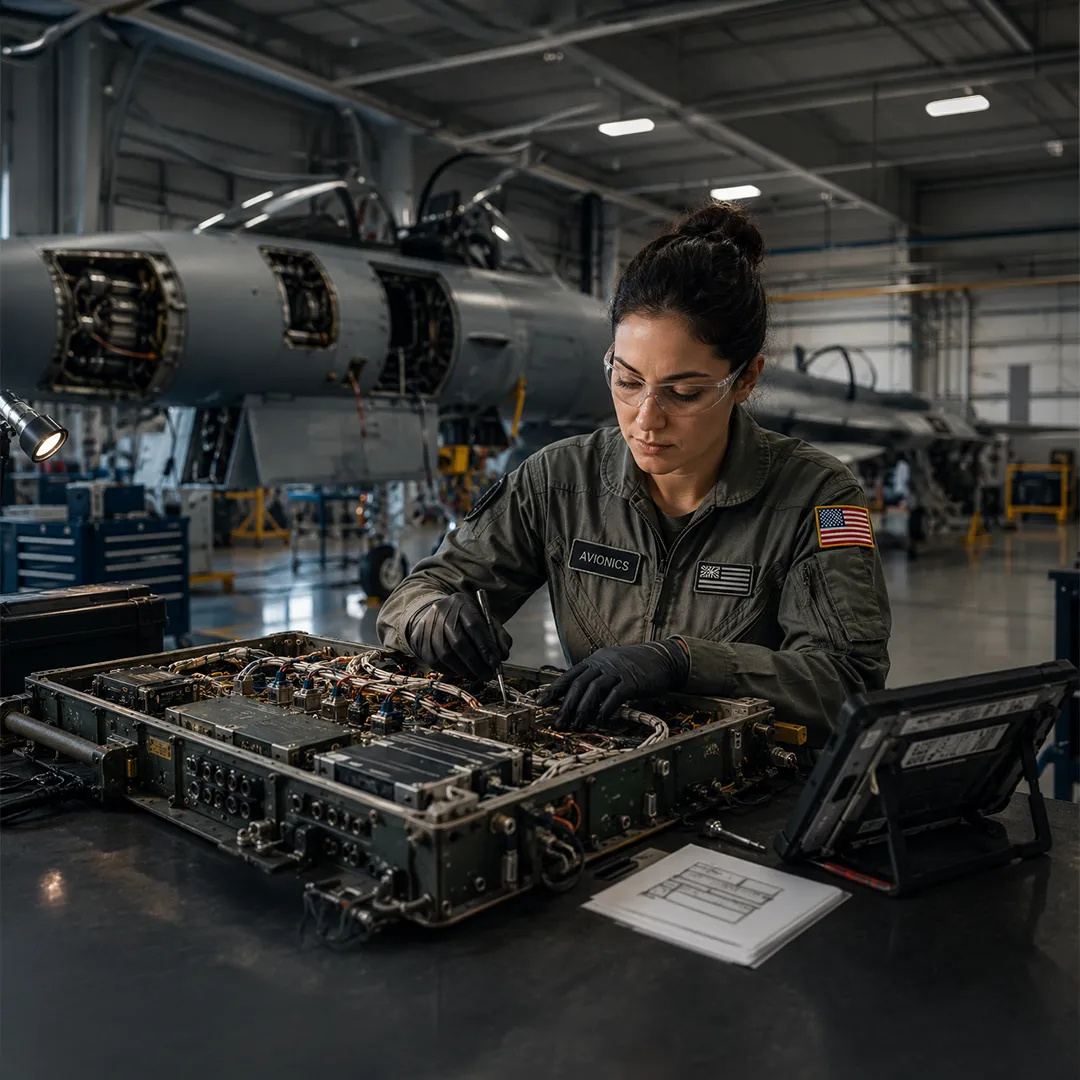
(Air Force 2A series, Navy AV rates) maintain and troubleshoot avionics systems, radar, navigation equipment, and electronic warfare systems on aircraft worth hundreds of millions of dollars. The civilian equivalents are A&P mechanics and avionics technicians, positions that require FAA certification and years of training that military personnel have already accumulated.
Nuclear engineers and reactor operators
(Navy Nuclear Power) operate and maintain naval nuclear reactors under operating conditions that would qualify as some of the most technically demanding environments in any industry. Navy nuclear veterans transitioning to civilian careers typically qualify for senior positions in commercial nuclear power, naval shipyards, and energy applications without additional technical training.
IT and cybersecurity professionals
(Army 25 series, Air Force 1D7X, Navy CTN) manage operational IT infrastructure, communications systems, and cybersecurity operations in environments with real adversarial threat. Their civilian equivalents are systems administrators, network engineers, and cybersecurity analysts, roles that are among the hardest for civilian employers to fill.
Logistics and supply chain managers run complex, time-critical distribution operations with limited resources and high stakes. The scale and operational rigor often exceeds what civilian logistics roles require.
Beyond Technical Skills: The Differentiators That Matter
The technical training is the foundation. But the attributes that make veterans exceptional on engineering programs often go beyond the technical:
Process discipline: Military training builds the habit of following documented procedures accurately, the first time, every time, regardless of how tedious the procedure is. For aerospace and defense programs where protocol compliance is safety-critical, this is not a soft attribute. It’s a core operational requirement, and veterans arrive with it already internalized.
Performance under pressure: Veterans have operated in high-stakes, resource-constrained, time-pressured environments where the consequences of failure were real and immediate. That experience produces a composure under pressure that is difficult to develop in any other context. Technical programs with hard delivery deadlines and high-visibility milestones benefit directly from it.
Leadership at multiple levels: Military service develops both leadership experience and followership discipline, the ability to lead a team with clarity and accountability, and the discipline to execute effectively as a member of someone else’s team. Most engineering programs need both, and veterans have practiced both.
Documentation and reporting discipline: Military work involves rigorous documentation of actions, conditions, and outcomes at every level. Veterans understand why documentation matters operationally, not just administratively. This translates directly to engineering program environments where configuration management, test documentation, and quality records are foundational.
Common Misconceptions That Cost Companies Good Hires
Despite the clear value case, veteran candidates are systematically underweighted in technical hiring pipelines for reasons that don’t hold up to scrutiny:
“I can’t evaluate their experience.” Military job codes (MOS for Army, AFSC for Air Force, NEC for Navy) translate directly to civilian roles in well-documented ways. Staffing partners with veteran recruiting experience can decode military backgrounds quickly and accurately.
“They won’t adapt to a civilian workplace.” Adaptation to new environments is a core military competency. Veterans who’ve been through multiple duty stations, multiple commands, and multiple mission types have adapted repeatedly. What they typically bring is a preference for clarity and explicit expectations, which is a feature, not a bug.
“Junior enlisted veterans aren’t senior enough for technical roles.” A Navy E-5 electronics technician with six years maintaining Aegis weapons system radar components has developed hands-on technical expertise that most civilian candidates with equivalent years of work experience haven’t approached. Job title and military rank don’t directly map to civilian seniority expectations.
The Financial Case: WOTC and Other Incentives
Beyond the talent case, employers who hire veterans can access meaningful financial incentives:
Work Opportunity Tax Credit (WOTC): Up to $9,600 per qualified veteran hired, with specific criteria by veteran category. For organizations hiring multiple veterans, this represents real tax liability reduction.
State-level programs: Many states, including California, offer additional hiring credits and training subsidies for veteran employment. The landscape changes, so verify current availability in your operating states.
Federal contractor advantages: For organizations with federal contracts, demonstrated veteran hiring is a favorable factor in past performance evaluations.
PDS actively recruits veterans for technical, engineering, aerospace, and IT roles and has been doing so for decades. Our recruiters understand how to evaluate military backgrounds and match veterans to programs where their specific training creates immediate value. Talk to our veteran recruiting team about accessing this talent pool.
