
Contract vs SOW Staffing in Aerospace Projects
When aerospace programs need external workforce support, two engagement models dominate: traditional contract staffing and Statement of Work engagements. The choice between them is consequential. Misaligning the model to the nature of the work creates compliance risk, budget unpredictability, management friction, or all three. Understanding when each model applies, and how to structure either correctly, is foundational for program managers and procurement teams who want external workforce support that actually works.

Contract Staffing in Aerospace: The Essentials
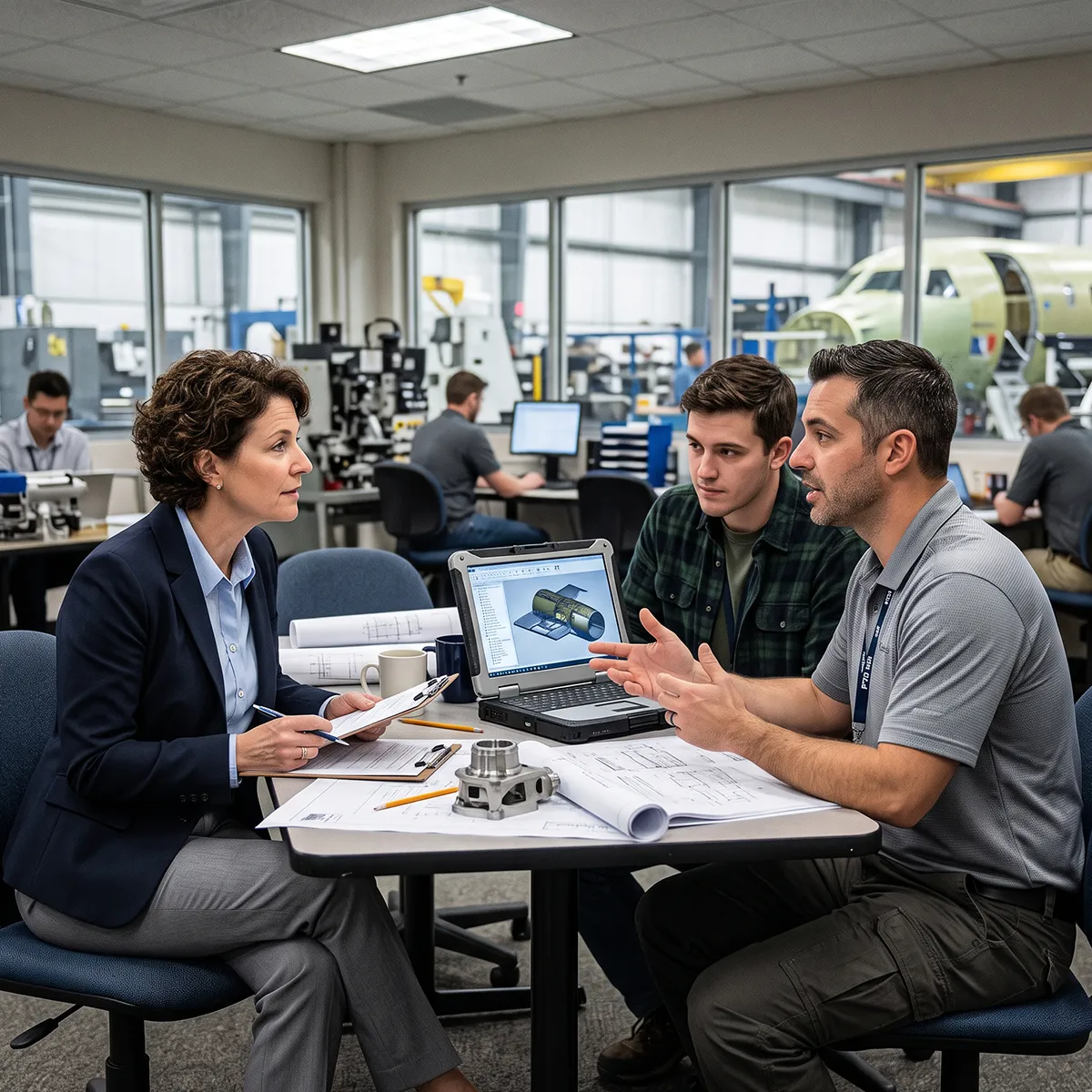
In a contract staffing model, PDS provides individual contractors who work under your program’s direct supervision. You set the priorities, direct the daily work, manage the pace, and hold the contractor accountable to your standards. PDS handles employment administration, payroll, benefits, workers’ compensation, and employment compliance, so you capture the capability without the employer obligations.
This model works well for work that requires deep integration into your team’s daily operations, evolving scope that changes week to week, or roles where the contractor must operate inside your systems, facilities, and security protocols.
Aerospace Contract Staffing Is Typically Appropriate For
- Engineers who need to be embedded in your daily design reviews, technical meetings, and program governance
- Cleared personnel operating within classified facilities under your security protocols
- Roles where the scope is undefined or will evolve significantly as the program progresses
- Long-duration program support where continuity within your management structure is important
- Surge roles during high-intensity program phases where your oversight and direction are constant
The compliance consideration: Contract workers should be managed in ways that don’t create co-employment risk. Directing what the contractor does and when they work is appropriate. Controlling how they do the work, their methods, tools, and professional judgment, starts to blur the line.


SOW Staffing in Aerospace: The Essentials
In a Statement of Work engagement, PDS is accountable for a defined deliverable, a design package, an analysis report, a test campaign execution, and a software module under an agreed scope, timeline, and acceptance criteria. PDS manages their team’s work; you manage the interface and accept the deliverable.
The SOW model transfers delivery accountability from your program to PDS for the defined scope. You define what you need. PDS commits to producing it. Changes to scope require formal amendment.
Aerospace SOW Engagements Are Typically Appropriate For
- Discrete, well-defined workstreams with clear acceptance criteria, a reliability analysis, a test protocol, an independent design review
- Work that can be performed with limited day-to-day integration with your program team
- Situations where cost certainty matters more than direct control over how the work is done
- Programs managing multiple independent technical workstreams simultaneously
- Deliverables where you want to hold a provider accountable for quality, not just effort
The compliance advantage: SOW workers are managed by PDS, not your program. This substantially reduces co-employment risk and typically makes the worker classification posture cleaner from a regulatory standpoint.

Comparing the Models for Aerospace Context
| Consideration | Contract Staffing | SOW |
|---|---|---|
| Scope definition | Can be fluid and evolving | Must be well-defined upfront |
| Day-to-day direction | Your program manages | PDS manages |
| Budget structure | Time and materials | Fixed or not-to-exceed |
| Change management | Flexible, informal | Formal amendment required |
| Team integration | Deep, daily | Bounded, output-focused |
| Co-employment exposure | Moderate, requires careful management | Low |
| Cost predictability | Lower | Higher |
| Best for | Ongoing, integrated support | Discrete, defined deliverables |
Getting the Structure Right at the Start
The most common and costly mistake is beginning an engagement under the wrong model and trying to correct it mid-stream. Starting a SOW when the scope isn’t actually defined leads to constant amendments and disputes. Starting a contract engagement when the work is really a defined deliverable creates management overhead and compliance exposure that compounds over time.
PDS will help you think through the right structure before the engagement begins, the questions to ask, the risk factors to consider, and how to document the arrangement to protect both parties. Talk to our aerospace team about structuring your next engagement.


The Bottom Line
Whether you’re a company searching for top technical talent, a recruiting firm building your practice, or an individual professional advancing your career in tech, deep expertise opens up opportunities that breadth cannot provide.
Firms, businesses, and individuals who commit to deep specialization while staying curious and informed about related areas position themselves to succeed in a market that increasingly values expertise over generalization. In the race between the specialist and the generalist, depth not only beats breadth in technology recruitment; it leaves it far behind.
Success in tech talent acquisition requires more than matching resumes to job descriptions. It involves understanding the specific technical skills that set good candidates apart from great ones, maintaining relationships with skilled professionals who drive innovation, and offering a service level that benefits clients and job seekers. That’s the power of specialized technology recruiting.
