

The confusion between mechanical engineers and systems engineers costs programs time and money regularly, and usually in ways that don’t get attributed correctly. The hire who was supposed to be a “senior engineer” but is actually a strong mechanical engineer trying to cover a systems engineering role produces inadequately documented requirements, unmanaged interface risk, and a design review process that reveals gaps at the worst possible time.
The roles are genuinely different. Getting the mix right is foundational to complex program success.
Why Fixed Headcount Isn’t Always the Right Tool
Permanent employment is optimized for permanence. Salary commitments, benefit obligations, equity vesting, and the organizational overhead of managing FTEs are structured for roles that will exist indefinitely. When a program has a defined end date, a surge period with a clear peak, or a skill need that’s specific to one development phase, permanent employment is the wrong financial structure for the need.
This isn’t about being cheap with the workforce. It’s about matching the financial structure of employment to the actual nature of the work. A composite materials analyst needed for a six-month qualification campaign creates more value as a contract engagement than as a direct hire who becomes either overhead or an awkward layoff when the campaign ends.


What Mechanical Engineers Do: The Core Value
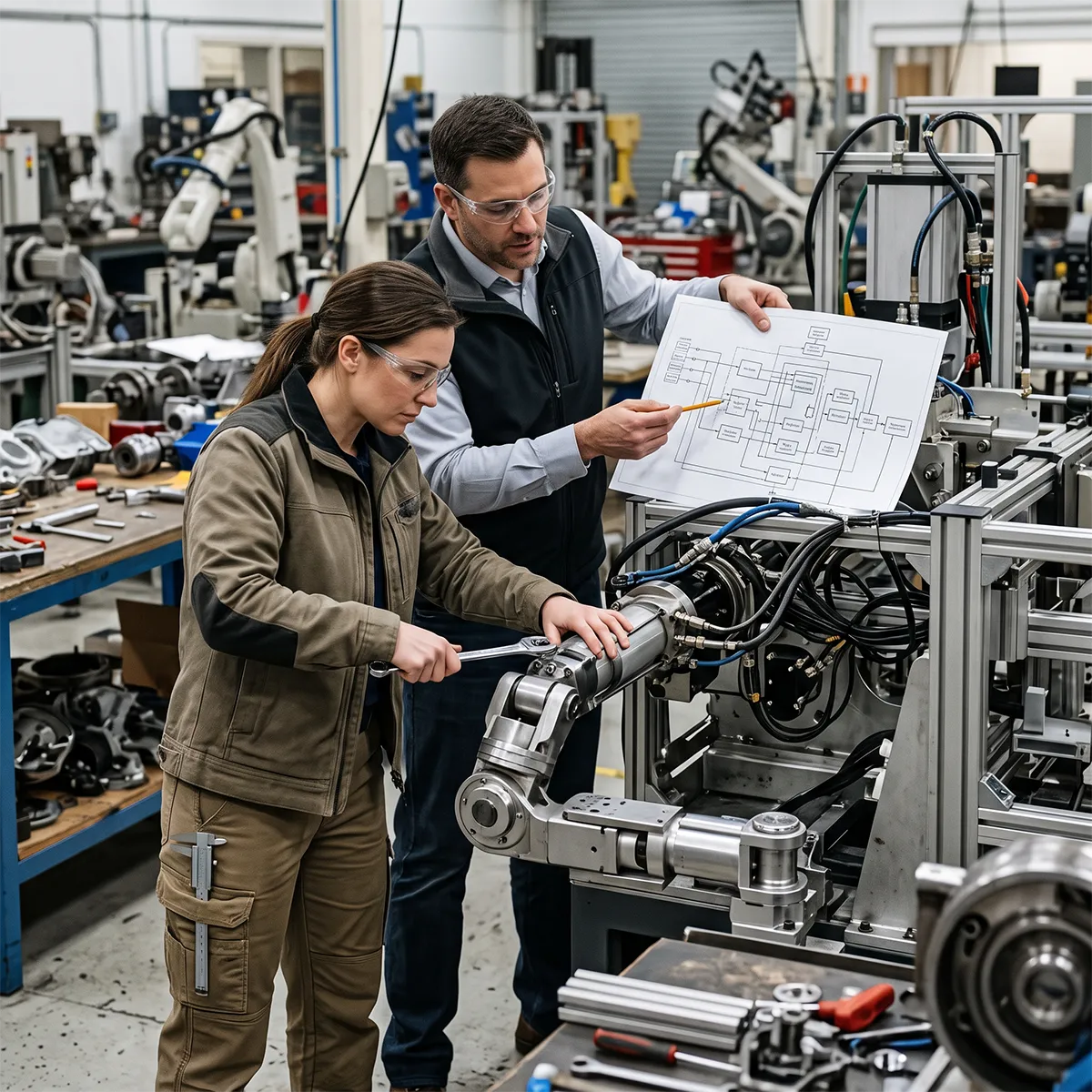
Mechanical engineers design, analyze, and validate physical hardware. Their work is grounded in the physical sciences, mechanics, materials, thermodynamics, manufacturing science, and their outputs are concrete: drawings, analysis reports, hardware that meets specifications.
On a product program, their primary responsibilities include:
- Detailed component and assembly design in CAD (CATIA, SolidWorks, Creo, NX depending on domain)
- Structural analysis, thermal analysis, and fatigue/fracture mechanics
- Tolerance analysis and GD&T definition
- Interface and packaging definition in coordination with adjacent subsystems
- Design for manufacturability review and supplier technical interface
- Qualification test support and hardware disposition
They go deep on a defined physical domain. A strong mechanical engineer on a propulsion subsystem knows that system at a level of detail that no one else on the program approaches. That depth is the point.
What Systems Engineers Do: The Core Value
Systems engineers manage the technical architecture of the whole. They don’t own any one subsystem in depth, they’re responsible for ensuring that all the subsystems work together to achieve the mission requirements, and that the interfaces between them are correctly defined, controlled, and verified.
- Their primary outputs are architectures and control documents:
- System requirements documents (SRDs) and system specifications
- Interface control documents (ICDs) and interface definition matrices
- Functional block diagrams and N² matrices
- Trade studies and technology selection analyses
- Verification and validation matrices (tracing requirements to test events)
- Technical risk registers and risk mitigation plans
Systems engineers ask: “Does this design satisfy the requirement?” and “Is the interface between this subsystem and the adjacent one correctly defined and controlled?” They are the mechanism by which complex programs maintain technical coherence across many engineers working in parallel.

The Right Ratio for Your Program Type
There’s no universal answer, but informed heuristics exist:
Simple products with limited external interfaces: a mechanical assembly with no embedded software, limited system complexity, and a single customer, can operate with one systems engineer supporting many mechanical contributors. The ratio might be 1 SE to 8–10 MEs.
Complex integrated systems: a satellite with propulsion, avionics, power, thermal, structure, and software subsystems, with government customer reviews and formal verification requirements, typically need systems engineering at 20–30% of the total engineering headcount. The SE burden is that high because the interfaces and requirements management complexity scales with subsystem count.
Software-intensive systems: avionics, embedded control systems, guidance systems, need even more systems engineering support because hardware/software interfaces are numerous, evolve rapidly during development, and carry significant verification burden.
Where Staffing Goes Wrong: The Three Common Mistakes
Loading a mechanical lead with systems engineering responsibilities
Strong mechanical engineers have domain-specific depth. They are typically not trained in requirements management, interface control, or verification tracing, and asking them to do both roles produces predictably incomplete systems engineering artifacts. Programs do this because they underestimate the systems engineering workload, not because the mechanical lead can actually cover it.
Hiring systems engineers without relevant domain background
A systems engineer who doesn’t understand the physics of the domain they’re supporting can’t meaningfully challenge the technical work. A GNC systems engineer who doesn’t understand orbital mechanics can’t catch a requirement violation when the subsystem analysis reports an anomaly. Domain awareness, not depth, but awareness, is a minimum requirement for systems engineering credibility.
Treating systems engineering as a documentation function
On programs under schedule pressure, systems engineering is often redefined as “keeping the documents current.” When that happens, it stops providing technical governance and becomes overhead. Systems engineers who are active technical contributors, who find real interface issues, who identify requirements gaps before they become rework, are among the highest-value contributors on complex programs. Systems engineers who are document managers are not.


How PDS Finds Both
PDS maintains separate recruiting pipelines for mechanical engineering placements and systems engineering placements in aerospace, defense, and industrial programs. Our recruiters understand the distinction, both what the roles require technically and how to evaluate whether a candidate’s background genuinely fits the role as scoped rather than the role as titled.
We can help you think through the right ratio for your program type, evaluate whether your current mix is creating risk, and find candidates in both disciplines with the genuine depth your program requires. Talk to our engineering recruiting team about staffing the right mix.
