

The Simple Definition
If you’ve been handed a staffing decision and someone mentioned “staff augmentation” without being entirely clear about what they meant, you’re in good company. The term gets used loosely in the workforce solutions industry, and different companies define it differently. This guide provides a straightforward explanation of what staff augmentation actually is, how it compares to alternatives, when it’s the right model, and what to watch out for.
Staff augmentation is the practice of supplementing your internal team with external professionals on a temporary basis. The external workers integrate into your existing team structure, work under your direction, and contribute to your projects alongside your permanent employees. The keyword is “augment”; you’re adding capacity and capability to your existing team, not handing off the work.
The staffing firm (like PDS) employs the workers and handles all employment administration: payroll, benefits, taxes, workers’ compensation, and employment compliance. You direct the work.
How Staff Augmentation Differs from Similar Models
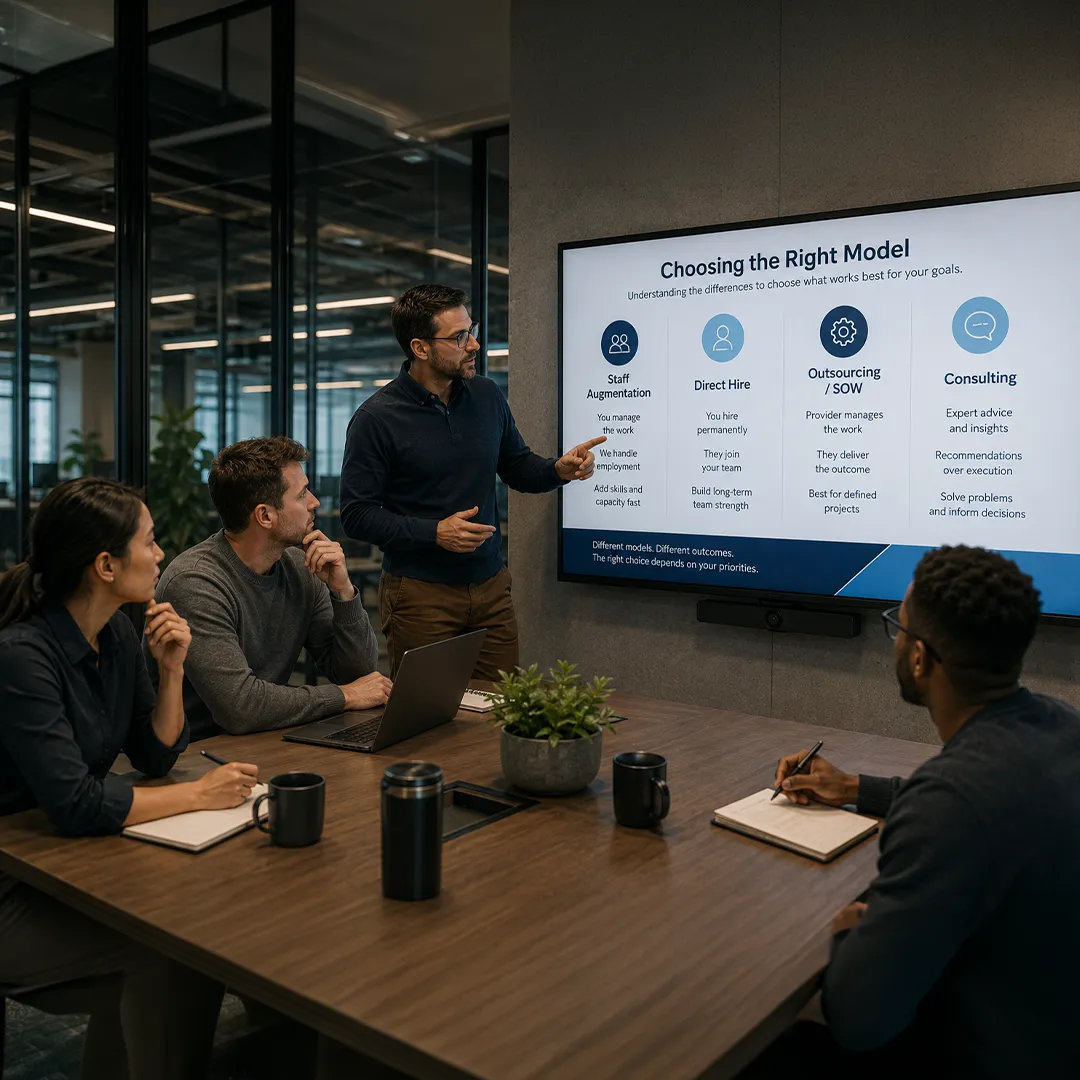
Understanding the boundaries between staff augmentation, direct hire, outsourcing, and consulting makes it easier to pick the right model for the work in front of you.

Staff Augmentation vs. Direct Hire
In direct hire, the professional joins your organization as a permanent employee. The recruitment firm helps you find them, but after they accept the offer, they’re yours: on your payroll, covered by your benefits, building tenure in your organization. In staff augmentation, they remain employed by the staffing firm throughout the engagement.
The practical difference: speed and commitment. Staff augmentation is faster to start (no offer negotiation, no benefits enrollment, no first-week payroll setup) and carries no long-term obligation. Direct hire creates a permanent employment relationship that is expensive to unwind if it doesn’t work out.
Staff Augmentation vs. Outsourcing / SOW
In outsourcing or a Statement of Work engagement, you hand off a function or a defined deliverable to an external provider who manages the work and is accountable for the outcome. The provider’s team does the work independently; you receive the deliverable.
In staff augmentation, you manage the work. The augmented professionals work under your direction within your processes. The provider handles employment; you handle outcomes.
The practical difference: control and accountability. Staff augmentation gives you control over how the work gets done; you’re accountable for what it produces. SOW gives the provider control over execution; they’re accountable for the defined deliverable.


Staff Augmentation vs. Consulting
Consultants typically provide expertise, advice, analysis, and recommendations on a problem or decision. They work relatively independently, bring an outside perspective, and deliver insights or recommendations rather than ongoing execution capacity.
Augmented staff provide ongoing execution capacity, building, coding, testing, analyzing, maintaining, rather than advising on how to do it. They’re integrated into your team as contributors, not engaged as external advisors.
When Staff Augmentation Makes Sense
Staff augmentation is typically the right model in a handful of recurring situations.


The Work Is Clearly Defined and Yours to Manage
If you can direct the day-to-day work and hold the professional accountable to your standards and processes, staff augmentation is appropriate. If you’d rather hand off the problem and receive a result, a SOW may be better.
You Need Skills Your Team Lacks for a Defined Period
A data migration project that requires Snowflake expertise your team doesn’t have. A product launch that requires a QA engineer for four months. An infrastructure buildout that needs a DevOps specialist for six months. These are classic staff augmentation use cases.


You Want Speed to Start
Staff augmentation can deploy qualified professionals in days to weeks. Direct-hire searches for senior technical roles often take 6-10 weeks. When time matters, augmentation is faster.
You Want Flexibility and a Chance to Evaluate Before Committing
The engagement can be extended, scaled up, reduced, or ended based on actual need, without the obligations of permanent employment. Contract-to-hire arrangements are a form of staff augmentation that allows both parties to evaluate fit during the engagement before making a permanent commitment.


Common Staff Augmentation Use Cases in IT and Engineering
Adding developers or engineers to an agile team for a sprint cycle or product phase. Bringing in a data engineer to build specific pipelines while you run a parallel direct hire search. Covering a critical technical role during an employee’s leave or during the search for a permanent hire. Scaling a QA team for a test campaign or release cycle. Augmenting an engineering team with a specialty analyst (FEA, CFD, thermal, reliability) for a defined analysis effort. Providing surge capacity on a production program during a high-intensity manufacturing phase.
The Compliance Consideration Worth Understanding
One nuance worth knowing upfront: when augmented staff work closely alongside your permanent employees, under your direct supervision, there can be co-employment considerations. The question regulators and courts ask is whether the economic reality of the relationship looks more like employment than independent contracting, based on factors like behavioral control, financial control, and the type of relationship.
Staff augmentation arrangements that are structured and managed correctly, where the staffing firm maintains genuine employer responsibilities and the client directs the work within appropriate bounds, carry manageable compliance risk. Arrangements that are effectively employment relationships in disguise carry meaningful exposure.
A reputable staffing agency understands these requirements, structures engagements appropriately, and provides guidance to clients about how to manage the relationship in ways that minimize co-employment risk.

The Bottom Line
PDS provides staff augmentation across IT, engineering, aerospace, and AI disciplines, with technical screening processes designed for the roles we fill rather than generalist keyword matching. Learn more about PDS staff augmentation or talk to our team about your specific needs.
